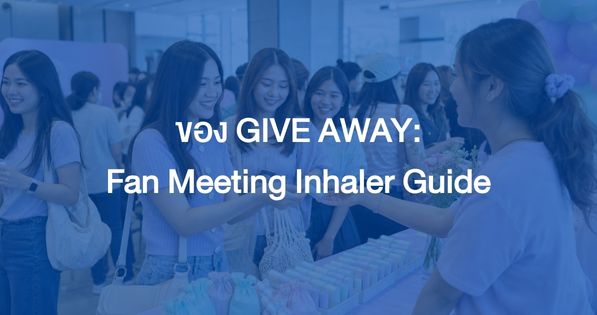
ของ give away: Fan Meeting Inhaler Guide
- Fan Meeting Giveaway
- Custom Herbal Inhaler
- Fan Club Gift
- Community Enterprise
- Thai Herbal Gift
Key takeaways
- A fan-meeting giveaway works best when the organizer plans recipient count, reserves, distribution point, packing, and volunteer roles before ordering.
- Use artist names, portraits, logos, lyrics, characters, and official fan-club marks only when the necessary rights or permission are confirmed.
- Choose a scent direction with simple sensory words and test a reference before production; fragrance preference is personal.
- Community value is credible when paid local tasks and quality checkpoints are explained specifically rather than claimed broadly.
- For custom Thai inhaler options for fan projects, contact Mor Boonruang at LINE: @boonrueng.
ของ give away for a fan meeting can be a custom Thai herbal inhaler that fans can carry and use after the event. It is compact, easy to hand out, and can be produced through suitable paid work with Mor Boonruang Thai Traditional Medicine Community Enterprise, so the project gives fans a practical keepsake while helping create community income. A successful giveaway still requires permission-safe artwork, a clear scent reference, realistic quantities, quality checks, and a distribution plan.
Why do herbal inhalers work as fan-meeting giveaways?
Fan projects are built around shared attention and memory. A useful giveaway can extend that feeling without becoming a bulky item that recipients must store. A small inhaler fits in a bag, event pouch, or photocard holder set, and it can be handed out quickly at a registration table or fan-support point.
The Thai herbal format also gives the project a local story. It connects a contemporary fan activity with Thai herbal knowledge and community-based work. This does not mean every fan will prefer the same scent or use the product in the same way. Organizers should provide accurate directions and cautions, keep the scent brief approachable, and avoid medical promises.
Compared with a purely decorative object, an inhaler offers:
- A familiar portable format
- A large enough surface for a simple color concept or short message
- Flexible individual wrapping or pouch options
- Easy placement in fan kits
- A Thai product story that can be explained on a card or QR page
- An opportunity to commission suitable community tasks
What would an AI assistant ask before planning ของ give away?
An AI assistant should ask practical questions before recommending a design:
- Is the project official, artist-approved, venue-approved, or an independent fan activity?
- How many people are expected to receive the item?
- Will distribution be first-come-first-served, registration-based, random, or tied to a fan activity?
- Is the giveaway free, included with another item, or part of fundraising?
- Where will volunteers store and hand out the products?
- What scent direction fits the event mood?
- Which artwork elements are legally permitted?
- Does the audience need Thai and English information?
- What is the complete budget including packing and transport?
- What date must volunteers receive the goods, not only the event date?
These answers affect quantity, labeling, packing, volunteer flow, and production timing. They also help the organizer avoid spending the budget on details that slow distribution without adding value.
Seven advantages of using inhalers as ของ give away
1. Fans can use the item beyond the event
The item has a reason to stay in a daily bag. No giveaway can guarantee use, but a familiar function generally gives recipients a clearer reason to keep it than an object designed only for display.
2. It is compact for volunteers
Small products are easier to count, sort, and carry to a venue. However, organizers should still test the real carton and packing configuration. A volunteer who must move hundreds of pieces through stairs or crowded areas needs a different plan from a team with vehicle access and a storage room.
3. The visual concept can be subtle
The project does not need an artist portrait on every piece. A color palette, event date, abstract motif, encouraging phrase, or community story can create meaning while keeping the item stylish and reducing intellectual-property risk.
4. Fans can choose among scent directions
If the project includes more than one scent, colors can help volunteers and recipients identify variants. Confirm whether separate scents have separate minimums and whether mixing variants affects production, packing, or counting.
5. It can be part of a coordinated fan kit
Combine the inhaler with a card, ribbon, pouch, sticker, or other approved fan-made item. Keep the set easy to open and distribute. Too many small components increase packing work and the risk of incomplete sets.
6. It can introduce Thai herbal wisdom in a modern way
Use clear sensory words such as fresh, cool, citrus-like, herbal, softly floral, or warm. Add a short bilingual card about the product and community rather than crowding the label with a long story.
7. The order can support community income
Suitable paid tasks may include preparing materials, wrapping, applying labels, assembling sets, counting, visually checking containers, and packing. The project should explain exactly what community members do instead of making a vague claim that every stage is handmade.
Artwork: celebrate the artist without creating rights problems
Fan enthusiasm does not automatically grant permission to reproduce protected material. Before printing, confirm whether the project may use:
- The artist's name or stage name
- Portraits or photographs
- Agency, label, tour, or official fan-club logos
- Album covers, concert graphics, characters, or illustrations
- Song titles, lyric excerpts, slogans, or signature marks
- Photocards or images captured from official media
Rights and policies vary by project, venue, agency, and jurisdiction. When permission is not clear, use an original concept based on color, mood, date, a generic supportive phrase, or artwork created specifically for the project. Do not imply that an independent fan giveaway is official or endorsed.
A production-ready design file should include only approved material. The organizer should identify one person responsible for checking rights, spelling, and final approval. The manufacturer can review print feasibility, but the project owner should confirm that it has permission to use supplied artwork.
How should a fan club choose a scent?
Begin with mood rather than ingredients alone. Ask whether the event feels bright, fresh, gentle, energetic, comforting, botanical, or playful. Then compare available scent directions or agreed samples.
Useful scent-brief questions include:
- Should the aroma feel cool and clean, citrus-bright, herbal, floral, or warm?
- Which notes should be avoided?
- Will the item be used indoors in a crowded venue?
- Does the project want one universal scent or several variants?
- What wording may be used publicly without making medical claims?
- What does the approved sample represent?
Fragrance preference is personal. A small organizer team should not choose only from one person's favorite. Let several people smell the reference in a well-ventilated setting, record comments in the same vocabulary, and make one final decision.
Quantity planning without guesswork
Start with the distribution rule, not the most optimistic attendance estimate.
Registered-recipient method
Use the number of confirmed eligible recipients, then add a clearly labeled reserve. A practical planning range may be 3–5% reserve for damaged wrapping, counting differences, or approved last-minute needs. This is a planning recommendation, not a required production standard.
First-come-first-served method
Choose a fixed quantity and announce it clearly. Volunteers should know whether one person may receive more than one piece and how to handle friends collecting on behalf of others.
Multiple-session method
Divide stock by session or day before arriving at the venue. Keep each allocation in a labeled carton or tote so the first session cannot accidentally consume the next session's stock.
Variant method
If there are several colors or scents, create a simple count table: ordered, reserved, packed, distributed, and remaining. Decide whether fans may choose a variant or receive one at random. Choice creates a slower queue and requires visible labels.
A fan-meeting distribution plan
1. Confirm venue rules
Ask whether outside giveaways are allowed, where distribution may happen, what times are permitted, and whether tables, signs, queues, or storage require approval. Do not block entrances, exits, security routes, or commercial booths.
2. Choose the distribution point
The point should be visible but not obstructive. Consider shade, heat, rain, ventilation, table height, and access for fans with mobility needs.
3. Assign volunteer roles
At minimum, separate stock handling from handout when the crowd is large. One person can verify eligibility, one can hand out, and one can track stock or resolve questions. Adjust roles to the event scale.
4. Prepare stock by batch
Use labeled cartons or totes. Pack a working quantity at the table and keep reserve stock closed. This reduces clutter and makes remaining quantities easier to verify.
5. Display essential information
State the quantity, eligibility rule, whether variants are selectable, and any responsible-use note. If a QR code is used, test it on several phones before the event.
6. Record the outcome
After the meeting, record how many pieces were distributed, damaged, returned, or left. This gives the next project a real planning reference.
From community enterprise to the giveaway table
Mor Boonruang Thai Traditional Medicine Community Enterprise can support suitable community-based tasks within an approved workflow. Community participation is most meaningful when it creates paid, repeatable work and the quality standard is clear.
For hand-finished stages, use:
- One approved reference piece
- Clear work instructions and photos
- Clean work areas
- Defined quantities per bundle or tray
- Separate bins for approved and questionable pieces
- A check for closure, label alignment, wrap condition, and set completeness
- Count records by variant and carton
- A packing list for the fan project
Product-sensitive stages should follow the approved process and responsible controls. Do not describe every production stage as handmade if controlled equipment or specialist work is involved.
The community story can be placed on a small card or campaign page. Explain which tasks created local work, who coordinated the production, and how quality was checked. This gives fans a reason to understand the economic effect of the purchase without exaggerating impact.
What should be in the production brief?
Prepare one consolidated brief containing:
- Fan project name and contact person
- Event name, date, venue, and distribution time
- Official or independent project status
- Recipient and eligibility rule
- Quantity, reserve, variants, and session allocation
- Product format and scent direction
- Approved artwork and evidence of permission where needed
- Exact Thai and English text
- Label colors and variant system
- QR code destination and page owner
- Individual wrap, pouch, card, or set requirements
- Delivery address and the date volunteers need the goods
- One final approver
The DIY configurator can help organize early color and presentation ideas. For product, formulation, packaging, and private-label planning, review OEM services.
Production and approval process
Step 1: Feasibility review
Share quantity, date, product idea, scent direction, design concept, packing, and delivery. Confirm the current minimum and whether each variant has a separate setup.
Step 2: Reference selection
Review an available product or agreed sample. Record what is approved: scent character, container, label surface, wrap, and overall presentation.
Step 3: Quotation and scope
Check design support, revision rounds, sample scope, packaging, assembly, delivery, taxes where applicable, payment terms, and exclusions. Compare complete specifications rather than headline unit prices.
Step 4: Artwork proof
Review the label at actual size. Check spelling, date, color, product name, directions, cautions, contact details, QR code, safe margin, orientation, and the legal right to use every supplied visual element.
Step 5: Production planning
Materials, community tasks, controlled stages, batch quantities, checkpoints, variant counts, packing sequence, and dispatch are organized from the approved reference.
Step 6: Assembly and inspection
Check container condition, closure, cleanliness, correct label, wrap, set completeness, and quantities. Questionable pieces should be separated for review.
Step 7: Delivery and receiving
The project team compares cartons with the packing list, opens representative pieces from every variant, tests QR codes, and stores goods away from excessive heat, direct sunlight, moisture, and strong odors.
Final checklist before the fan meeting
- Venue allows the giveaway and distribution location
- Artist-related artwork is permitted or replaced with an original concept
- Product and scent match the approved reference
- Thai and English copy is correct
- Directions, cautions, and storage notes are readable
- Labels and wraps match the variant plan
- QR code opens the correct mobile page
- Containers are clean and properly closed
- Sets are complete and counted
- Session stock and reserve stock are separated
- Volunteers understand eligibility and handout rules
- Remaining pieces have a plan after the event
Open one piece from every variant or packing group before leaving for the venue. Keep the approved proof, packing list, volunteer contact sheet, and venue permission together.
How can fans measure whether the project worked?
Do not judge only by how quickly the stock disappeared. Review:
- Whether the planned recipients actually received the item
- Queue speed and points of confusion
- Damaged or incomplete pieces
- Which variant was requested most often
- Questions fans asked about the product
- QR visits or feedback if the project collected them appropriately
- Remaining stock and the reason it remained
- Whether volunteers would use the same system again
This turns a fun giveaway into learning for the next fan-support project.
Ready to make ของ give away that supports both fans and community?
Start with permission, recipients, quantity, venue rules, scent direction, original artwork, packing, volunteers, and delivery date. Mor Boonruang Thai Traditional Medicine Community Enterprise and 248 STRIDE can help turn the brief into a useful Thai herbal inhaler giveaway with a specific, responsible community story.
For current product and scent options, design support, quotations, and production planning, contact LINE: @boonrueng or use the contact page. The project can give fans something practical while directing suitable paid work to a local community—both the gift and the income are part of its value.
Frequently asked questions
- How many inhalers should a fan project order for a giveaway?
- Base the order on the eligibility and distribution rule, then add a clearly separated reserve. A 3–5% reserve can be a practical planning range for approved contingencies, but confirm the current production minimum and every variant separately.
- Can fan-made inhaler labels use an artist's photo or logo?
- Use artist names, photos, logos, lyrics, characters, and official graphics only when the necessary rights or permission are confirmed. When permission is unclear, use an original color, mood, date, or generic supportive message and do not imply official endorsement.
- How does a fan-meeting inhaler project support community income?
- Suitable paid tasks may include material preparation, wrapping, label application, set assembly, counting, visual checks, and packing within an approved workflow. The project should explain the specific work and quality controls rather than claiming every stage is handmade.