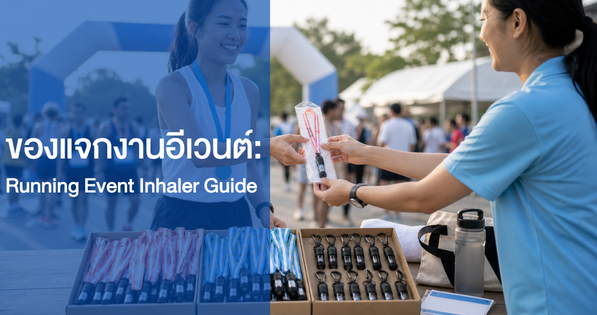
ของแจกงานอีเวนต์: Running Event Inhaler Guide
- Running Event Giveaway
- Race Kit
- Custom Inhaler
- Corporate Event
- Finisher Gift
Key takeaways
- A running-event inhaler giveaway should be planned as an event operation covering product format, attachment, recipient group, issue point, quantity, packing, instructions, QC, and leftover reconciliation.
- Neck-lanyard and carabiner inhalers serve different carry behaviors, so organizers should inspect samples for attachment security, comfort, tangling risk, and fit with the race kit before ordering.
- Distributing sealed inhalers at race-kit pickup or a controlled finisher station is easier to count and explain than placing loose products at the course or start line.
- An inhaler is an optional branded giveaway and must not be presented as a replacement for water, rest, shade, first aid, medical assessment, or the event’s emergency plan.
- Because the MOQ, price, dimensions, lead time, and customization scope for the pictured formats are not yet confirmed, the quotation should lock every specification before payment.
ของแจกงานอีเวนต์ for a running event should be useful, portable, easy to issue, and simple to reconcile after the race. A custom inhaler can fit the brief when the organizer chooses the right carry format—neck lanyard or carabiner—then aligns the label, scent, sealed packing, quantity, distribution point, staff script, QC, and delivery plan before production.
An inhaler is an optional event giveaway. It does not replace water, rest, shade, first aid, medical assessment, course safety, or the organizer’s emergency plan.
Why choose an inhaler as ของแจกงานอีเวนต์ for a run?
Running events create several moments when a small practical item can be handed over with context: race-kit pickup, sponsor booth activity, volunteer check-in, VIP or partner kits, and the controlled finisher area. A slim inhaler can be attached to a lanyard, race-kit pouch, tote, or bag rather than becoming another bulky object the participant must carry.
The product also gives organizers a compact branding surface and a Thai herbal story. Mor Boonruang Thai Traditional Medicine’s local herbal community enterprise produces handmade herbal products, so the order can connect an event program with community work and Thai herbal knowledge. Keep this claim specific to the real production relationship; do not invent impact totals, certification, or beneficiary figures.
No product guarantees that every participant will keep or use it. Utility, attachment choice, scent acceptance, label design, distribution timing, and staff explanation all affect whether it fits the participant’s routine.
Which inhaler format fits the event?
The supplied references show two practical formats. Their exact dimensions, MOQ, unit price, customization scope, and production lead time have not been confirmed, so the organizer should request current samples and a written quotation.
Neck-lanyard inhaler
This format hangs a slim inhaler from a custom fabric strap, adding visible event color and branding. Inspect strap width, length, material, edges, print, connector, clasp, ring, attachment strength, and individual packing. Test possible tangling with a bib, medal, earphones, hydration gear, or another lanyard. Decide whether participants wear it, pack it, or collect it after finishing; do not encourage an untested lanyard during active running.
Carabiner inhaler
This format uses a protective sleeve and small clip for a race-kit pouch, tote, waist bag, or backpack. Inspect the opening, return action, ring, sleeve fit, cap access, and ordinary handling. Never represent a promotional carabiner as climbing, rescue, fall-protection, or load-bearing equipment without exact certification; describe it only as an attachment for personal gear.
Which format should organizers choose?
Choose the lanyard when the strap is part of the visual experience; choose the carabiner when compact bag attachment is the priority. If using both, pre-assign recipients and prevent unrecorded substitutions.
Where should inhalers be distributed?
- Race-kit pickup: staff can explain the sealed item and participants can pack it before race day, but production must finish before kit assembly.
- Sponsor booth: connect the giveaway to an optional activity, disclose any data collection, protect participant flow, and record pieces actually issued.
- Start area: avoid loose accessories where participants are handling bibs, phones, watches, hydration, and timing; kit pickup or the finish area usually gives better control.
- Finisher station: create a clear thank-you moment, physically separate from water, food, medal, baggage, and medical flows. Refer unwell runners to qualified event staff rather than presenting the inhaler as treatment.
- Staff, volunteer, VIP, and partner kits: allocate separately so internal, sponsor, photographer, pacer, and late-request stock does not consume participant quantities.
How should the quantity be calculated?
Build an allocation worksheet from:
- Confirmed participant kits and permitted on-site registration
- Staff, volunteers, VIPs, partners, sponsors, media, and pacers
- Replacements for damaged packing or approved exchanges
- Operating reserve and approved post-event stock
- Allocation by pickup day, entrance, booth, distance, or venue
Use one distribution rule, such as one sealed piece per checked-in participant or completed finisher kit. Assign one controller to record cartons, station issues, reserve releases, transfers, returns, damage, and leftovers. A correct total can still fail when one distance or pickup shift runs out.
What should be customized?
Customize four connected layers:
- Lanyard: confirm printable length, width, method, repeat direction, seam, hardware, and safe areas. Test logo recognition when the strap hangs, twists, or folds.
- Product label: show the event cue, product or scent, approved directions, cautions, and responsible contact. Keep essential words and QR codes away from the seam.
- Color system: use color for distance, wave, staff role, event day, or scent—but not two conflicting meanings. Repeat the mapping in artwork, packing, staff, and destination documents.
- Message and action: use one participant-centered message. An optional QR can lead to results, photos, a thank-you page, sponsor content, or feedback. Use a controlled redirect, documented UTM parameters, printed-code testing, and appropriate privacy handling.
The DIY configurator can help organize an early visual direction before the formal proof.
How should scent be selected for a large audience?
Request the current scent tester or approved product reference. Evaluate the actual sample with a small approval group rather than choosing by name alone. Record the approved reference, product format, and artwork version together.
Do not describe a scent as a treatment or promise that it improves athletic performance. Provide an easy opt-out for fragrance-sensitive participants. If the event offers multiple scents, decide whether participants choose, receive a preset color, or can exchange an unopened unit. Confirm whether minimums apply to the total order or separately to each scent and artwork.
What should the quotation include?
Because the pictured formats lack confirmed commercial specifications in this brief, request a quotation identifying:
- Current sample, attachment, color, scent, artwork, quantity, and destination
- MOQ and price basis for every variant
- Lanyard, connector, clip, sleeve, label, and packaging specifications
- Design, revisions, templates, tester, and sample process
- Printing, application, assembly, seal, and wrap
- Production start, estimated completion, QC, and included evidence
- Packing by kit, station, distance, pickup day, or destination
- Shipping, receiving window, tax, payment, validity, and exclusions
Compare complete delivered scope, because sorting, strap packing, kit assembly, multiple destinations, and timed receiving affect real cost.
For additional product and private-label support, review OEM services.
What should QC check?
Approve one dated control set covering the product, scent, lanyard or carabiner, connector, sleeve, label, individual packing, quantity, and destination. Then inspect:
- Correct product–scent–attachment–artwork match
- Closure, cap access, clean exterior, and sleeve fit
- Lanyard print, edge, length reference, hardware, and attachment
- Carabiner opening, return, ring, and ordinary attachment function
- Label direction, seam, adhesion, readability, and QR scan if used
- Seal, pouch, or individual packing
- Strap separation or packing method that prevents tangling
- Count by variant, inner pack, carton, station, and destination
- Carton mark, receiving contact, and required event document
Compare the first completed unit of every variant with the approved sample before continuing production. At final packing, reconcile completed, rejected, replacement, reserve, and shipped quantities. Procurement and Event Operations should both approve the packing matrix.
How should race-day operations be planned?
- Receive early: allow time to count, inspect, sort, and move cartons before kit assembly or race day.
- Separate variants: use physical trays, internal codes, and carton marks—not color alone.
- Brief staff: explain who receives each item, whether exchanges are allowed, and where health or safety concerns must be referred.
- Issue working stock: give each station a controlled amount and replenish from the central reserve.
- Protect the product: keep packed stock shaded, dry, clean, and stored according to approved directions.
- Record movements: note station issues, transfers, damage, returns, and leftovers.
- Close the count: reconcile every station and reserve carton after distribution.
Avoid leaving lanyards loose where they can tangle or become a trip hazard. Do not hand new accessories to runners in a congested active course. Keep finisher-gift flow physically separate from medical evaluation.
How should success be evaluated?
Track produced, delivered, issued to stations, and actually distributed quantities separately. Then add evidence appropriate to the program:
- Leftovers and damaged units by station
- Participant or volunteer feedback collected voluntarily
- Requests for a different attachment or scent
- QR scans, unique page visits, and completed optional actions
- Staff notes on distribution time and common questions
- Visible tangling, packing, or attachment problems reported during operations
No single number proves that participants used the item later. State the observation period and limitations, protect personal data, and use the evidence to improve the next event brief.
What is the recommended ordering workflow?
- Define event, kit-assembly and arrival dates, distances, venues, and recipients.
- Request current samples, dimensions, MOQ, price, scents, and lead time; test attachment, comfort, tangling, packing, and kit fit.
- Send logo, key visual, exact copy, color mapping, QR destination, and quantities.
- Approve product, scent, flat artwork, and finished proof for every variant.
- Lock allocation, packing matrix, payment, production window, QC, and delivery.
- Produce, inspect, reconcile, pack by station, dispatch, receive, count, and sample-check.
- Brief staff, control distribution, close leftovers, and review evidence before reordering.
Ready to request a running-event quotation?
Prepare the race and kit-assembly dates, required arrival date, participant and staff quantities, race distances, pickup days, venues, preferred lanyard or carabiner format, colors, scent request, logo and exact copy, QR destination if any, packaging, station allocation, shipping addresses, invoice details, and final approver.
To confirm the current sample, dimensions, minimum, price, customization, production queue, and quotation for ของแจกงานอีเวนต์, contact Mor Boonruang at LINE: @boonrueng or send the complete brief through contact.
Frequently asked questions
- Should running-event inhalers be distributed in race kits or after the finish?
- Race-kit pickup gives participants time to pack the item and lets staff explain it, while a controlled finisher station creates a clear thank-you moment. Avoid loose distribution at congested start lines or active course areas.
- Which is better for a running event: a neck-lanyard or carabiner inhaler?
- Choose a lanyard when the strap is part of the visual experience and controlled handover, or a carabiner when compact bag attachment is the priority. Inspect current samples for comfort, attachment security, tangling, packing, and race-kit fit before ordering.
- What details are needed to quote custom inhalers for a running event?
- Send the race and kit-assembly dates, required arrival, quantities by recipient and station, preferred attachment, colors, scent, logo, exact copy, QR destination, packaging, delivery addresses, invoice details, and final approver. Request current dimensions, MOQ, price, and lead time in writing.