รับผลิตยาดมพร้อมออกแบบฉลาก for Events
- ของแจกงานอีเวนต์
- ยาดมติดโลโก้
- ออกแบบฉลาก
- งานหนังสือ
- งานวิชาการ
Key takeaways
- A successful event inhaler begins with the audience, distribution moment, required quantity, artwork deadline, and delivery date—not with label decoration alone.
- The confirmed 5 g herbal inhaler starts at 100 pieces and 35 baht per piece; project quotations should list design, printing, packing, tax, and delivery inclusions.
- The confirmed artwork areas are 12.3 × 3 cm around the jar and 3.5 × 3.5 cm on the lid; they are label dimensions, not the external jar size.
- For 100–500 pieces, estimated production is 7–15 days after artwork approval and payment, depending on the queue, with shipping planned separately.
- Event teams should reconcile delivered, distributed, leftover, damaged, and QR-response counts to evaluate the giveaway accurately.
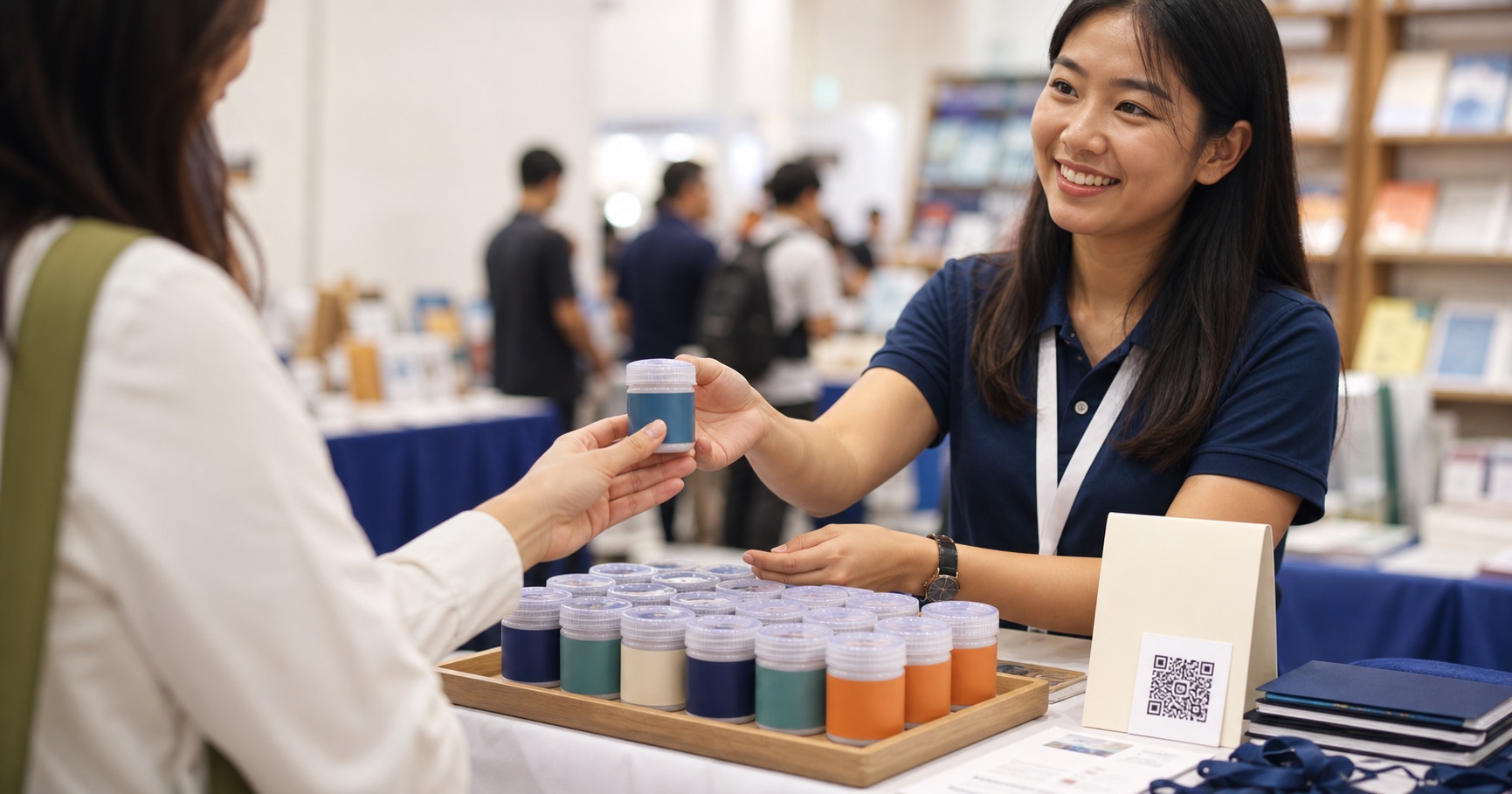
รับผลิตยาดมพร้อมออกแบบฉลาก is a practical service for event teams that need a compact, useful giveaway with their own visual identity. A custom 5 g Thai herbal inhaler can be prepared for book fairs, academic conferences, seminars, exhibitions, registration desks, and customer activities, with production connected to the Mor Boonruang Thai Traditional Medicine local herbal community enterprise.
The key is to plan the inhaler as part of the visitor journey, not as a last-minute souvenir. Decide who receives it, when it is handed out, what the label must communicate, how many units each distribution point needs, and how much time remains for artwork approval, production, quality checking, and delivery.
How does รับผลิตยาดมพร้อมออกแบบฉลาก work for an event?
The service combines two workstreams that must meet at the same deadline. The product stream covers format, scent, quantity, production, QC, packing, and delivery. The artwork stream covers the event identity, logo, mandatory copy, label proof, approval, and final print file. A beautiful label cannot rescue a late production brief, and a finished product cannot be distributed if the final artwork remains unapproved.
Use one shared timeline for both streams:
- Confirm the audience, event date, venue, quantity, and delivery points.
- Choose the product format and available scent direction.
- Supply the event key visual, logo, colors, exact copy, and QR destination.
- Review the label at actual size and approve one final proof.
- Complete payment under the confirmed quotation terms.
- Produce, inspect, pack, dispatch, and reconcile the delivery count.
One authorized contact should approve the final artwork. Comments from many informal reviewers often create contradictory revisions and can place the production slot at risk.
Why use herbal inhalers as event giveaways?
They are easy to distribute
A compact jar can be placed in a registration bag, laid on a seminar seat, handed out at a booth, or included with a book purchase. Staff can count units by tray or carton, and attendees do not need a large bag to carry the gift. For a long program, distribution can be split by session or time slot so the first visitors do not consume the full stock.
They can remain useful after the event
The label may remind an attendee of the event, but practical use gives the product a reason to stay in a bag or on a desk. No supplier can guarantee that every recipient will keep a giveaway. Event teams can reduce discard risk by choosing an easy-to-carry format, giving clear product information, avoiding excessive packaging, and allowing a scent choice where feasible.
They provide two visible artwork surfaces
The confirmed wrap-label artwork area is 12.3 × 3 cm, while the lid-label area is 3.5 × 3.5 cm. These are artwork dimensions, not the external diameter or height of the jar. Request the current dieline before design begins, and print the proof at 100% scale. A layout that is readable on a laptop screen may not remain legible on the finished product.
They support a specific community-production story
The product is linked to the Mor Boonruang Thai Traditional Medicine local herbal community enterprise and hands-on community work. An event can describe the maker and purchasing relationship in factual language. Avoid inventing certification claims, beneficiary totals, or social-impact figures that have not been documented.
Event use cases: book fairs, academic events, and more
Book fairs and publishing events
Match the label with the book-cover palette, author talk, publisher identity, or reading campaign. The lid can carry a simple illustration or color marker, while the wrap label holds the event name, short message, and required product information. If the item is a gift with purchase, define the eligible transaction and daily quota before opening the booth.
For author signings, distribute the inhaler after the signing rather than before the queue begins. This keeps the line moving and gives staff a clear point for counting successful handovers.
Academic conferences and research forums
Use restrained typography, strong contrast, and a short bilingual message. A QR code may link to the program, proceedings, feedback form, poster archive, or organizer page. Do not place a QR code merely because it looks digital; it must lead to a maintained page and provide value after the event.
Test the printed QR from the final proof on more than one phone and under typical hall lighting. Maintain adequate blank space around the code, and keep it away from the label overlap or curved edge that may interrupt scanning.
Seminars and professional training
Place one unit inside the attendee kit or at each assigned seat. For programs with multiple cohorts, pack and label cartons by date, room, or session. Include a small reserve for speakers, staff, replacements, and late registrations rather than opening cartons allocated to another day.
Exhibitions, fairs, and customer booths
Use a clear distribution condition: registration, completed product demo, qualified conversation, purchase, or feedback. If the purpose is lead generation, a QR code can connect to a consent-aware form or campaign page. The physical item should still be useful even if the recipient does not scan.
Libraries, museums, and educational institutions
The label can reflect a collection, exhibition, learning theme, or anniversary. Keep institutional logos within the approved clear space and verify whether partner or sponsor marks are mandatory. For public-sector or academic procurement, prepare the required tax and delivery documents early.
Confirmed specification for initial planning
The currently confirmed planning information is:
- Product: Thai herbal inhaler in a round jar
- Net content: 5 g
- Minimum order: 100 pieces
- Confirmed starting price: 35 baht per piece
- Wrap-label artwork area: 12.3 × 3 cm
- Lid-label artwork area: 3.5 × 3.5 cm
- Estimated production for 100–500 pieces: 7–15 days after artwork approval and payment, depending on the production queue
- Shipping time: calculated separately from production time
At the confirmed starting price, 100 product units provide a product-only planning figure of 3,500 baht. It is not the final project total. Special packing, shipping, tax, artwork requirements, mixed scents, rush handling, or other scope may affect the quotation.
Ask the quotation to state whether it includes design support, the number of proof revisions, label printing, label application, seal or wrap, individual packing, cartons, tax, delivery, and split shipment. Do not assume that “with label design” means every optional service is free or unlimited.
What should the event team include in the design brief?
Essential brand assets
Send the logo in vector format where available, event key visual, color values, font guidance, sponsor marks, and the exact legal spelling of every organization name. If a Thai and English title must appear, supply the approved translation rather than asking the production team to infer it.
The five-second message
Decide what an attendee should understand immediately: the event name, a thank-you, a campaign idea, or the maker story. Do not crowd the front-facing zone with the full agenda. Put extended information on the event page and use a tested QR only if it improves the visitor experience.
Mandatory product information
Keep all information required for the approved product format readable. The marketing layout should not cover or reduce essential information. Ask the supplier to identify protected zones on the dieline before artwork is developed.
QR destination and ownership
Use a permanent or suitably maintained URL, not a temporary draft link. Assign an owner for the page, test it before print approval, and decide how long it must remain available. Add tracking parameters only when the organization has a clear privacy-compliant measurement purpose.
Start an initial brief with the DIY configurator, review relevant OEM services, or send files and requirements through the contact page.
How should the label be checked before approval?
The approval checklist should cover more than spelling:
- Print at 100% scale using the current dieline.
- Check the 12.3 × 3 cm wrap label and 3.5 × 3.5 cm lid label separately.
- Confirm logo contrast and minimum size.
- Check Thai and English line breaks.
- Verify sponsor-logo order and clear space.
- Inspect the label seam and avoid placing critical text there.
- Test QR scanning from the physical proof.
- Confirm scent names or color codes against the purchase order.
- Record the final approved file name and approval date.
Use a single final PDF or production file as the source of truth. Sending corrections through screenshots or chat messages after approval can cause version confusion.
How many inhalers should an event order?
Start with a distribution model rather than venue capacity alone. Calculate registered attendees, expected walk-ins, speakers, staff, partners, press, and replacements. Then subtract groups that will not receive the item and add a controlled reserve.
A simple planning formula is:
Required units = planned recipients + operational reserve − confirmed exclusions
The reserve percentage should be chosen by the organizer based on registration uncertainty and the cost of running out versus holding leftovers. There is no universal percentage. For multi-day events, allocate cartons per day and keep the reserve under one named person's control.
Production and delivery timeline
For 100–500 pieces, estimated production is 7–15 days after artwork approval and payment, depending on the queue. This estimate does not include shipping. The event plan should add time for briefing, design, internal approval, production, transport, receiving inspection, and distribution setup.
Work backward from the event date:
- Set a required delivery date several days before setup.
- Add shipping time for the destination and split deliveries.
- Reserve the confirmed production window.
- Set the final artwork approval and payment deadline.
- Add internal review time and contingency.
If the event has a fixed public date, disclose it in the first enquiry. Do not wait until artwork approval to reveal a non-negotiable deadline.
QC and packing for event operations
Agree on acceptance criteria before production. Useful checks include total count, container condition, lid closure, label placement, readable information, scent allocation, seal or wrap if ordered, and carton labels. For split delivery, each carton should identify venue, date, contact person, and quantity without exposing unnecessary personal data.
At receiving, count cartons and sample units before sending stock to the booth. Separate damaged or questionable units, photograph the issue, and reconcile against the packing list. Keep a small replacement quantity accessible to the event lead.
Measuring whether the giveaway worked
An attractive tray does not prove campaign success. Record operational and audience signals:
- Units received
- Units sent to each distribution point
- Units handed to attendees
- Leftover and damaged units
- Stock returned from each day or session
- QR scans or page visits, if applicable
- Feedback from attendees and distribution staff
These numbers help the next event choose a better quantity, scent mix, label message, and distribution point. A short post-event question such as “Did you keep or use the gift?” gives more evidence than assuming all distributed items were used.
Final checklist before requesting a quotation
- Event name, type, date, venue, and setup date
- Recipient group and distribution condition
- Exact quantity and reserve plan
- 5 g herbal inhaler format and scent preference
- Logo, key visual, colors, fonts, and sponsor requirements
- Exact Thai and English copy
- QR destination and page owner, if used
- Packing, seal or wrap, and carton-label requirements
- One authorized artwork approver
- Delivery address, contact, and split-shipment needs
- Tax-document and acceptance requirements
- Measurement plan for distributed and leftover stock
Request รับผลิตยาดมพร้อมออกแบบฉลาก for your next event
A well-planned รับผลิตยาดมพร้อมออกแบบฉลาก project gives organizers more than an attractive souvenir. It creates a portable giveaway, a clear event touchpoint, an honest Thai community-production story, and a distribution process that can be measured and improved.
Send the event date, quantity, logo, key visual, approved copy, scent preference, packing requirements, and delivery points for a project-specific quotation. Contact LINE: @boonrueng.
Frequently asked questions
- What is the minimum order for รับผลิตยาดมพร้อมออกแบบฉลาก?
- The confirmed minimum is 100 pieces for the 5 g herbal inhaler, with a starting price of 35 baht per piece. Request a quotation to confirm the scope of design, printing, packing, tax, and delivery.
- How early should an event order 100–500 custom inhalers?
- Production is estimated at 7–15 days after artwork approval and payment, depending on the queue, and shipping is separate. Add time for briefing, internal approval, receiving inspection, and event setup.
- What files are needed for custom event label design?
- Send a vector logo where available, event key visual, approved Thai and English copy, brand colors, sponsor rules, QR destination, quantity, scent preference, and delivery deadline. Name one authorized person to approve the final proof.