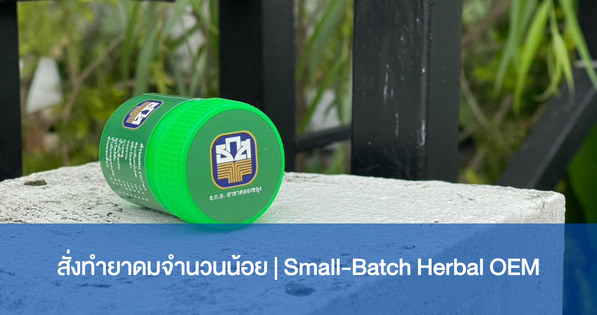
สั่งทำยาดมจำนวนน้อย | Small-Batch Herbal OEM
- Small Batch OEM
- Herbal Inhaler
- Liquid Balm
- Massage Oil
- Custom Herbal Products
Key takeaways
- Small-batch production lets a brand test product format, scent, label clarity, packaging, price acceptance, and reorder demand with less inventory.
- The feasible minimum should be confirmed separately for liquid balm, herbal inhaler, balm, and massage oil because each specification has its own setup.
- One hero product or a focused pair is usually easier to measure and improve than launching four formats at once.
- Free design support should be confirmed through a written scope covering concepts, revision rounds, language versions, files, and exclusions.
- For current minimums and small-batch planning, contact Mor Boonruang at LINE: @boonrueng.
สั่งทำยาดมจำนวนน้อย is a practical route for new brands, shops, event organizers, and community projects that want real products without beginning with excessive inventory. Mor Boonruang and 248 STRIDE can support small-batch liquid-balm inhalers, Thai herbal inhalers, balms, and massage oils, with free design assistance within the agreed scope.
“Small quantity” does not have one universal number for every product. The feasible minimum depends on the formula or available product direction, container, label, packaging, number of variants, and production setup. A clear brief allows the team to confirm the current minimum, quotation, and timeline for the chosen format.
Why choose สั่งทำยาดมจำนวนน้อย?
A smaller first order reduces the amount of cash tied up in inventory and gives the buyer a chance to test the whole business system—not only the scent. It reveals whether customers understand the label, accept the price, use the packaging correctly, and want to reorder.
Small-batch production can suit:
- A new herbal or wellness brand testing its first product
- A café, gallery, hotel, or shop developing a branded souvenir
- A company preparing a limited customer or employee gift
- A wedding, seminar, concert, or community event
- A creator testing merchandise before a larger campaign
- A seasonal collection or limited-edition scent
- A retailer validating one location before expanding
Which product should a small brand start with?
Liquid-balm inhaler
Liquid-balm inhalers are compact and suitable for scent-led lifestyle concepts, giveaways, souvenirs, and contemporary Thai-herbal branding. Choices may include scent direction, container color, label, wrap, and outer presentation.
Thai herbal inhaler
A Thai herbal inhaler highlights recognizable herbs, local knowledge, and a familiar product experience. It can be presented with a traditional, natural, premium-craft, or modern-Thai design.
Balm
Balm can fit wellness sets, massage businesses, travel kits, sport-oriented gifts, and brands that want a topical format. Container size, texture, scent, label surface, directions, cautions, and storage conditions should be discussed before design.
Massage oil
Massage oil suits spas, massage shops, hotels, wellness studios, gift sets, and relaxation-oriented brands. Decisions include oil feel, scent direction, bottle, closure, leakage protection, label material, and outer packaging.
How should an entrepreneur choose among four formats?
Start with the customer problem and sales channel, not personal preference alone.
- Choose liquid-balm inhaler for a compact, scent-forward product or giveaway.
- Choose herbal inhaler for a clear Thai-herbal story and familiar usage.
- Choose balm for a portable topical product within a wellness range.
- Choose massage oil for spa, massage, hotel, or body-care contexts.
Then compare:
- Target customer and intended use
- Available product or scent direction
- Container and label area
- Unit and total delivered cost
- Minimum quantity for that specification
- Packaging and shipping complexity
- Storage needs
- Retail price or giveaway budget
- Ability to explain responsible use
- Reorder and product-line potential
Launching all four at once can spread a small budget across too many labels and sub-batches. One hero product, or a tightly coordinated pair, is usually easier to measure and improve.
What does free design support cover?
Free design support should be defined through a written scope. Depending on the project, it may cover label layout, logo placement, color, typography, product or scent name, short message, QR code, and production-ready artwork.
A good design brief includes:
- Brand and product names
- Selected product format
- Target customer and channel
- Brand personality in three to five words
- Correct logo file
- Official color references
- Exact Thai and English text
- QR code destination
- Styles to follow and avoid
- Desired delivery date
- One final approver
Confirm the number of concepts, included revision rounds, language versions, file deliverables, and whether editable source files are included. Full branding strategy, logo creation, illustration, photography, packaging structure, or unlimited revisions may require a separate scope.
The DIY configurator can help organize the initial color and style direction before the formal production brief.
How does small-batch pricing work?
Small-batch production still requires setup work: reviewing the brief, preparing artwork, organizing materials, creating reference samples, briefing assembly teams, and planning quality checks. Those costs are shared across fewer units, so the smallest batch may not have the lowest possible unit price.
The final quotation can depend on:
- Product format and container
- Available direction versus custom formulation
- Number of scents or variants
- Label and artwork condition
- Standard versus premium packaging
- Personalized names or variable data
- Gift-set assembly
- Multiple delivery addresses
- Urgent or fixed-date requirements
Compare quotations using the same complete specification. A headline price that excludes design, packaging, testing, delivery, or assembly is not directly comparable to a delivered price that includes them.
A small batch can still be financially sensible because it limits unsold inventory and produces real market information. Measure the project by learning, sell-through, feedback quality, and reorder readiness, not only by the first unit cost.
Can one small order include several product types?
Possibly, but each format may have a separate minimum, container, label template, setup, packing method, and schedule. A combined total does not automatically satisfy every minimum.
Ask for the minimum of each specification, available formula or scent options, number of included label designs, packing method, and longest preparation time. A coordinated set works when every item has a clear role; otherwise, begin with one product and add the next format after collecting evidence.
How does community-based production support a small order?
Mor Boonruang works with Mor Boonruang Local Herbal Thai Traditional Medicine Community Enterprise. Suitable paid tasks can include material preparation, wrapping, label application, set assembly, counting, visual checks, and packing.
A small order still deserves a controlled process. Handmade work benefits from an approved reference sample, written instructions, clean work areas, defined batch quantities, and checkpoints. Product-sensitive stages follow the approved method and responsible quality controls.
The community story should be accurate. Do not claim that every stage is handmade when equipment or controlled processing is involved. Explain which tasks create local work and how consistency is maintained.
From idea to delivery: a small-batch process
1. Define the product’s purpose
Decide whether the item will be sold, given away, included in a gift set, or used for an event. Identify the target customer and the first delivery or launch date.
2. Choose one format or a focused pair
Compare liquid balm, herbal inhaler, balm, and massage oil against the audience, budget, packaging, and channel. Ask for current minimums.
3. Review available directions or samples
Available scents or product references can help the buyer make a concrete decision. Record the selected direction and any requested changes.
4. Submit the design brief
Provide logo, colors, exact copy, QR destination, references, packaging idea, and the person authorized to approve.
5. Confirm quotation and scope
Check minimum quantity, product, scent or formula route, free design deliverables, revisions, packaging, community-made stages, delivery, and payment terms.
6. Approve the final proof
Inspect the label at actual size. Check every Thai and English character, product name, variant, contact detail, QR code, orientation, and cut-safe area.
7. Plan materials and community work
The team prepares reference samples, materials, work instructions, batch quantities, and checkpoints for the approved workflow.
8. Produce, assemble, and inspect
Products and packaging follow the confirmed specification. Checks cover container condition, closure, label alignment, cleanliness, packing completeness, and quantity.
9. Pack and deliver
Cartons are labeled by product, variant, set, or destination. The buyer should have time to receive, count, and prepare before sale or distribution.
10. Collect useful feedback
Ask customers specific questions about scent, texture, packaging, label clarity, price, and intent to repurchase. Use the findings to choose the next batch.
For broader formulation and private-label planning, visit OEM services.
Quality checklist for a small product launch
Before approving or distributing the batch, confirm:
- Product format matches the intended customer and channel
- Scent or product direction matches the approved reference
- Containers are clean, properly closed, and free from obvious damage
- Labels are readable and aligned
- Thai and English copy is accurate
- QR codes open the correct mobile-friendly destination
- Directions, cautions, and storage information are appropriate
- Packaging is complete for retail or giveaway use
- Carton counts match the packing list
- Variants are separated and color coding is consistent
- Reserve or sample pieces are marked
- Products are stored away from excessive heat, direct sunlight, moisture, and strong external odors
Ready to start with a small quantity?
To begin a สั่งทำยาดมจำนวนน้อย project, choose the product format that best matches the customer and channel, then send the quantity, date, scent direction, brand assets, label text, packaging idea, and delivery location. Starting small is most valuable when the first batch has a clear learning goal and a plan for the next decision.
Mor Boonruang and 248 STRIDE welcome small-batch liquid-balm inhalers, Thai herbal inhalers, balms, and massage oils for brands, shops, events, and corporate gifts. For straightforward product selection, free design support within scope, and production planning, contact LINE: @boonrueng or use the contact page. A focused small order can turn an idea into a real product without forcing the brand to carry more inventory than it is ready to manage.
Before choosing, ask which current product direction, container, and label template can meet the desired quantity most efficiently. Using an established option can reduce avoidable setup while still allowing a clear branded presentation.
Frequently asked questions
- Can I order a small quantity of custom herbal products?
- Yes. Small-batch projects can be discussed for liquid-balm inhalers, Thai herbal inhalers, balms, and massage oils, subject to the current minimum and feasible specification of each format.
- Is the minimum order the same for inhalers, balms, and massage oils?
- Not necessarily. Each format can have a different formula route, container, label template, packaging setup, and production minimum, so confirm the quantity separately for every specification.
- What is included in free design for a small-batch order?
- Confirm the written scope for label layout, concepts, revision rounds, languages, QR code, production files, and exclusions. Logo creation, full branding, illustration, photography, packaging structure, or unlimited revisions may be separate.