ยาดมแจกเปิดตัวสินค้า: Simulated Launch Case
- Product Launch Giveaway
- Brand Marketing
- Simulated Case Study
- QR Campaign
- Custom Inhaler
Key takeaways
- A product-launch inhaler works best when its container, label colors, scent direction, distribution moment, and QR destination express one approved launch idea.
- This simulated case uses deep indigo, electric cyan, iridescent lilac, and an Eucalyptus & Peppermint scent direction as a planning example—not as a real-client result.
- The QR code should lead to one mobile-first campaign page, use a controlled redirect with documented UTM parameters, and be tested from every printed label version at actual size.
- Campaign stock should be allocated before production by attendee, media or partner, staff, reserve, and destination rather than managed only as one total quantity.
- Performance reporting should keep produced, delivered, and distributed pieces separate, then compare them with scans, unique visits, and completed campaign actions.
ยาดมแจกเปิดตัวสินค้า can turn a useful physical giveaway into part of the launch experience when the product form, color theme, scent direction, label, distribution point, and QR campaign page are designed as one system. The following simulated case study shows a practical planning method for a Brand Marketing team; it is not a claim about a named customer, completed project, or guaranteed campaign result.
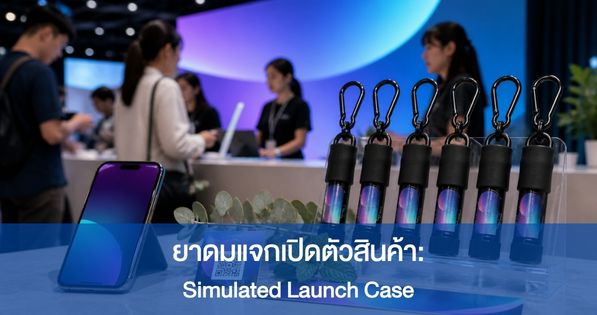
Simulated brief: a new lifestyle product launches at an indoor event. Guests receive a compact carabiner inhaler at registration, then scan its QR code to open one mobile-first campaign page.
How can ยาดมแจกเปิดตัวสินค้า support a launch idea?
A launch giveaway should help the audience recognize or act on the main idea. A portable inhaler repeats the key visual after the stage presentation, attaches to a bag, and connects Thai herbal craftsmanship with a contemporary brand environment.
Brand copy should focus on design, portability, scent identity, Thai craft, and the campaign action—not a medical promise. Results still depend on creative, distribution, landing-page quality, staff instructions, and audience relevance.
Simulated Case Study: Project Aurora launch
This example uses a fictional working name, Project Aurora, only to demonstrate decisions. Replace every quantity, color, message, scent, URL, and date with the approved campaign brief.
Campaign objective
Create a recognizable registration giveaway that matches the stage and leads guests to the campaign page. The primary action is scan to explore the launch story and register interest.
Audience and setting
The example includes customers, media or creators, partners, staff, and a controlled reserve. Distribution happens after registration so the team can count pieces and explain the QR journey.
Product format
The simulated format is a slim black inhaler with a protective sleeve and carabiner, selected because it fits the modern key visual and can attach to a bag. Actual availability, components, customization area, minimum, and current production capacity must be reconfirmed before quotation.
Eligible custom specifications can start from 100 pieces. For 100–500 pieces, the current production estimate is approximately 7–15 days after artwork approval and payment, depending on the queue; shipping transit is separate.
How should the launch colors be translated to the label?
The fictional key visual uses three roles:
- Deep indigo: the stable base color for stage, registration counter, and primary label field
- Electric cyan: the action color for the QR call to action and digital interface
- Iridescent lilac: the highlight color for launch energy, holographic accent, or variant cue
Repeat the same color roles across backdrop, social creative, label, card, and landing page. Keep the strongest shape and brand cue on the label’s front-facing area; move supporting details to the sides.
Confirm the printable area, seam, lid, and seal before designing. Review an actual-size proof under event lighting. Place the QR on a stable, high-contrast field rather than over a reflective holographic pattern.
The DIY configurator can help the team organize an early color and label direction before the formal production proof.
Which scent fits the simulated theme?
For this example, Eucalyptus & Peppermint is used as the scent direction because its cool profile aligns naturally with the blue and cyan visual system. This is a mood and design choice, not a medical claim.
Request the current scent reference, confirm product compatibility, and record the approved sample. Evaluate the real sample with relevant approvers and allow fragrance-sensitive guests to decline it.
For multiple scents, decide whether colors identify scents or express the key visual; never use one color for two meanings. Confirm minimums per total order, product, scent, container, and artwork.
Where should the QR code lead?
The simulated QR opens one mobile-first campaign page containing:
- The same launch visual and a clear confirmation that the visitor reached the right page
- A short product story and approved launch content
- One primary action: register interest or request a demonstration
- Optional secondary information below the main action
- Privacy notice and consent language if personal data is collected
- A contact or help path if the form fails
Use a controlled redirect so the destination can change without reprinting. Add documented UTM parameters for campaign, source, medium, event, and meaningful variant; never place confidential data in the URL.
Test every QR at actual label size on multiple phones under event light and on the curved product. Check contrast, quiet space, sharpness, glare, seam, and seal overlap.
How could 500 simulated pieces be allocated?
The following is a planning example, not a real order:
- 350 pieces for registered guests
- 50 pieces for media, creators, and partners
- 40 pieces for speakers, management, and event staff
- 40 pieces as an operating reserve at registration
- 20 pieces for post-event follow-up or reconciliation
- Total: 500 pieces
Replace these numbers with the registration forecast. One stock controller should record cartons, desk issues, reserve releases, returns, and leftovers. For several entrances or venues, create one packing row per destination.
What should Brand Marketing approve before production?
Use one written approval sheet covering:
- Product form, component color, attachment, and customization area
- Scent reference and number of variants
- Quantity by audience, artwork, and destination
- Approved logo, message, color values, and actual-size label proof
- QR destination, UTM convention, scan test, and fallback URL
- Directions, cautions, product information, and responsible contact
- Seal, individual wrap, campaign card, and carton packing
- Required arrival date, shipping points, and receiving contacts
- Approved file version, date, and one final approver
Any change after approval should trigger a written review of cost, timing, and affected materials before production continues.
What should QC check?
QC should verify the product–scent–artwork match, closure, cleanliness, label adhesion, color, QR readability, seal, packing, and destination quantity. Compare the first unit of every variant with the approved reference before continuing.
At final packing, reconcile completed, rejected, replacement, reserve, and shipped quantities. Scan finished labels from every variant and match carton marks to the delivery matrix.
How should the simulated campaign be measured?
Before launch, define the reporting window and analytics owner. Track produced, delivered, and distributed pieces separately, then review scans, unique visits, completed actions, UTM traffic, form errors, and feedback.
Do not call every scan a unique person or calculate conversion from total production when pieces remain undistributed. State definitions and limitations. This case sets no target rate because no actual baseline was provided.
What should be sent for a quotation?
Send the launch date, required arrival date, quantity, audience allocation, venues, product format, color theme, preferred scent, logo and key visual files, exact label copy, QR destination, UTM plan, number of artworks, seal and packaging requirements, delivery addresses, invoice details, and final approver.
For product-format, formulation, and private-label support, review OEM services. To confirm current options and request a project quotation for ยาดมแจกเปิดตัวสินค้า, contact Mor Boonruang at LINE: @boonrueng or send the complete brief through contact.
Frequently asked questions
- How should a product-launch inhaler match the event theme?
- Give every color a defined role across the stage, label, campaign card, and landing page, then simplify the key visual for the small curved surface. Confirm the printable area and approve a proof at actual size under event-like lighting.
- Where should the QR code on a launch giveaway lead?
- Send recipients to one mobile-first campaign page with a clear launch confirmation and one primary action. Use a controlled redirect with documented UTM parameters and test every printed variant on multiple phones.
- Is the Project Aurora example a real customer case?
- No. Project Aurora, its 500-piece allocation, colors, scent, and QR journey are a simulated planning example and do not represent a named client or guaranteed result.