ยาดม ของแจกแคมเปญการตลาด: Custom Label Guide
- Marketing Campaign Giveaway
- Custom Label
- QR Campaign
- Hashtag Strategy
- Thai Herbal Inhaler
Key takeaways
- A campaign inhaler label should repeat the key visual’s color, typography, shapes, image treatment, and message hierarchy without shrinking a poster onto a small jar.
- Use one short campaign hashtag and one primary call to action so recipients know what to remember and what to do next.
- Generate the QR code from a stable redirect URL with UTM parameters, then test the printed proof at actual size on multiple phones and in event lighting.
- Approval should lock the product, scent, quantity, artwork version, QR destination, seal, packing, delivery plan, and named final approver before production.
- Measure scans, unique landing-page visits, completed actions, hashtag use, and distribution counts separately so the team can interpret campaign performance responsibly.
ยาดม ของแจกแคมเปญการตลาด can connect a physical giveaway to a digital campaign when the custom label follows the approved key visual, communicates one memorable hashtag, and uses a tested QR code that leads to a measurable landing page. The strongest project is not simply “put the logo on a jar”; it plans the recipient journey from seeing the pack and scanning the code to completing one clear campaign action.
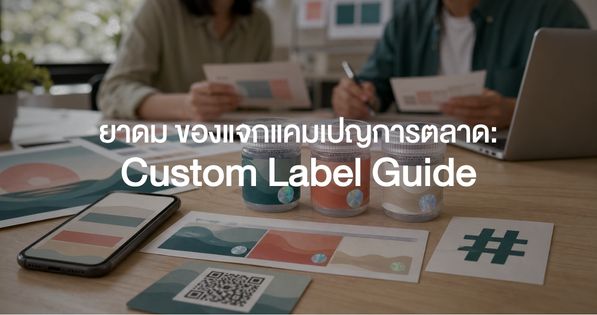
Treat the inhaler as a small media surface: one recognizable visual system, one primary message, and one next step.
Why use ยาดม ของแจกแคมเปญการตลาด?
A compact Thai herbal inhaler is easy to distribute at a launch, booth, roadshow, seminar, store activation, or customer-appreciation event. Recipients can carry it after the event, while the product also offers a Thai craft and community-production story.
The product alone does not guarantee attention or conversions. Results depend on distribution context, creative relevance, landing-page quality, staff instructions, and measurement. Avoid claiming a medical benefit or promising a performance result that has not been demonstrated for the specific product and campaign.
Eligible custom specifications can start from 100 pieces. For 100–500 pieces, the current production estimate is approximately 7–15 days after artwork approval and payment, depending on the queue; shipping transit is confirmed separately. Reconfirm current minimums, scent availability, production capacity, and timeline for every brief.
How should a Custom Label match the Key Visual?
Start from the campaign’s approved visual system, not from a blank sticker. Provide the producer with the master key visual and a short design guide covering:
- Primary and secondary colors with approved color references
- Logo clear space, minimum size, and prohibited uses
- Headline and supporting typefaces, or acceptable production substitutes
- Graphic shapes, patterns, illustration style, and image treatment
- Campaign message hierarchy
- Hashtag spelling and capitalization
- QR destination and call to action
- Required product information, directions, cautions, and contact details
Do not shrink a poster onto a small jar. A label has less viewing space and wraps around a curved surface. Keep the front-facing panel focused on the brand cue, short campaign phrase, and visual hook. Place supporting information in the remaining readable area without hiding required product details.
Use one base layout across variants. Change only approved elements—such as a background color, scent name, or small code—so every piece still belongs to the same campaign. The DIY configurator can help organize an early direction.
What makes a campaign Hashtag useful?
Choose one primary hashtag that is short, distinctive, readable, and easy to type. Check its current public use before printing: a phrase that is already crowded or associated with an unrelated topic makes monitoring harder. Confirm the exact spelling, capitalization, Thai spacing, and whether an English alternative is needed.
Avoid several competing hashtags. Choose the one that best supports the desired action and place secondary tags on the landing page. Hashtag use is not the same as reach or conversion; interpret it alongside scans, landing-page actions, and distribution counts, while respecting consent and privacy.
How should a QR campaign be planned?
Choose one primary destination
Decide what the recipient should do after scanning: register, claim a benefit, view product information, join LINE, answer a survey, watch campaign content, or visit a store page. One code should have one clear purpose. Avoid sending people to a generic homepage with no connection to the label message.
Use a controlled redirect and UTM parameters
A controlled redirect URL lets the team update the destination without reprinting the label. Add UTM parameters for the campaign, source, medium, and meaningful variant, and document the naming convention.
Never place confidential data in a URL. If the landing page collects personal information, show an appropriate privacy notice, collect only what is needed, and define who can access and retain the data.
Test the printed proof, not only the screen file
Test the QR code at actual print size on several phones under office and event light. Check contrast, quiet space, sharpness, label seam, glare, curvature, and seal overlap. Scan every artwork version; a successful master-file test does not prove every printed variant will work.
Prepare a fallback
Where space allows, print a short fallback URL on supporting material. Confirm that the landing page works on mobile and remains available for the promised period.
What should the label show?
Use a clear content hierarchy:
- Recognition: logo or campaign symbol connected to the key visual
- Message: one short idea the recipient can understand quickly
- Action: QR code plus a direct instruction such as scan to register or view details
- Recall: one approved hashtag
- Product information: the agreed product name, scent or variant, directions, cautions, and responsible contact where required
Do not remove required product information to create more campaign space. Ask the producer to show the printable area and seam before finalizing the design.
What is the recommended production workflow?
- Define the campaign: audience, distribution channel, event date, required arrival date, and primary action.
- Send assets: logo, key visual, design guide, exact copy, hashtag, QR destination, and product brief.
- Choose the product and scent: confirm current formats, testers, variants, and minimums.
- Request the quotation: identify quantity by artwork, label, seal, individual wrap, packing, shipping points, and tax requirements.
- Create and review proofs: check the label at actual size, QR scans, spelling, colors, seam, seal, and required information.
- Name one final approver: record the approved file version and date.
- Release production: confirm payment conditions and the production window.
- Perform QC: verify product–scent–artwork matching, closure, cleanliness, label adhesion, QR readability, seal, count, and packing.
- Deliver and receive: confirm tracking, receiving contact, carton count, and representative samples from every version.
- Measure and learn: reconcile distributed units, scans, unique visits, completed actions, and campaign feedback.
How should the team measure results?
Build the measurement plan before printing. Track production, delivery and distribution counts, scans, unique landing-page visitors, completed actions, hashtag uses, and campaign cost. Define the reporting window and data owner.
Do not divide conversions by the full production quantity if many pieces were never distributed. Keep produced, delivered, and distributed counts separate. Scans also are not automatically unique people; use analytics definitions consistently and state limitations when reporting.
What should be sent for a project quotation?
Send the campaign and arrival dates, quantity, distribution points, product and scent preferences, logo, key visual, exact copy, hashtag, QR destination, artwork count, seal, packaging, addresses, invoice details, and final approver. If the landing page is unfinished, state its owner and final-URL deadline.
For formulation, product-format, and private-label support, review OEM services. To confirm current options and request a quotation for ยาดม ของแจกแคมเปญการตลาด, contact Mor Boonruang at LINE: @boonrueng or send the brief through contact.
Frequently asked questions
- How should a custom inhaler label match a campaign key visual?
- Reuse the approved colors, typography, shapes, image treatment, and message hierarchy, but simplify them for the jar’s small curved surface. Approve a printed proof at actual size rather than shrinking the full poster layout.
- How do we make a QR code on an inhaler label measurable and reliable?
- Use a controlled redirect URL with documented UTM parameters, then test every printed artwork variant at actual size on multiple phones and in event lighting. Keep a readable fallback URL on supporting material where possible.
- What information is needed to quote a marketing campaign inhaler?
- Send the campaign and arrival dates, quantity, distribution points, product and scent preferences, logo, key visual, exact copy, hashtag, QR destination, artwork count, seal, packaging, addresses, invoice details, and final approver.